How it opens.
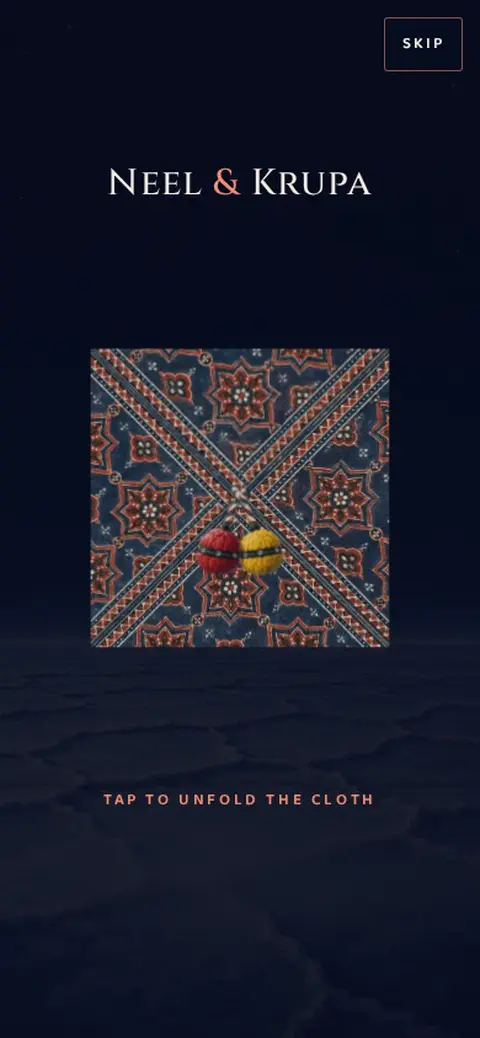
The White Rann of Kutch on a full moon night, painted as paper planes of salt, a far cluster of round bhunga huts and a calm indigo sky. Held up in front of it is a folded rumaal, ajrakh lining outside, tied with a woollen tassel. The guest taps it, the four corners unfold one by one, and the mirror-work embroidery comes up in colour. At its heart a big round mirror catches the light, the moon lifts out of it into the sky, and the desert lights from the moon outward until the names rise underneath.
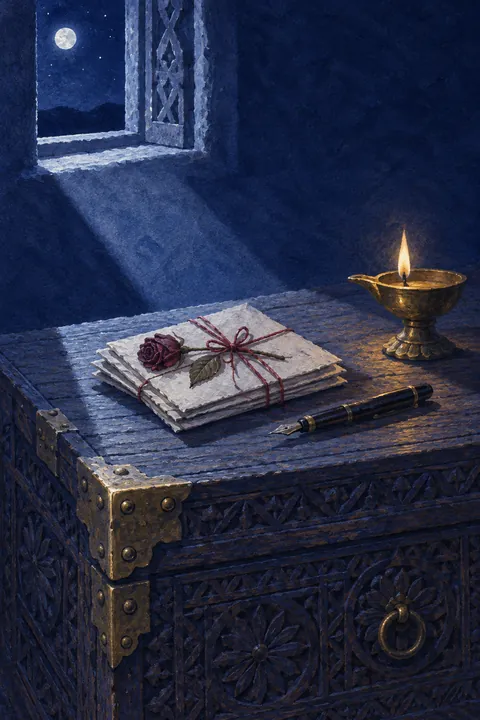
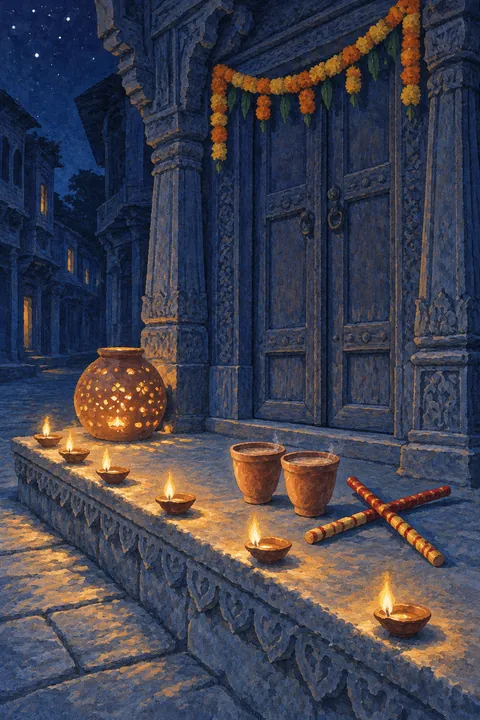
The rest of the invitation stays in Kutch. The families are named over the bhunga village, the story (a Navratri night in an Ahmedabad pol, a year of letters, a question on the salt) hangs inside a hut in lippan clay frames set with small mirrors, each function is its own embroidered patch laid on the moonlit salt with that night's moon worked out from the date, and the reply is written on a hemmed cotton cloth under the same moon.
- 01 A folded Kutchi cloth whose four corners unfold on real hinges
- 02 The moon rises out of the mirror at its heart and lights the white Rann
- 03 Paper planes of salt, far huts and sky that answer the scroll
- 04 Four functions on four embroidered patches, each with that night's moon